Stone casali and walks in the Subasio hills
A field note on stone casali around Assisi, kitchen gardens, olive oil, and the walks that leave Santa Maria degli Angeli for Monte Subasio.
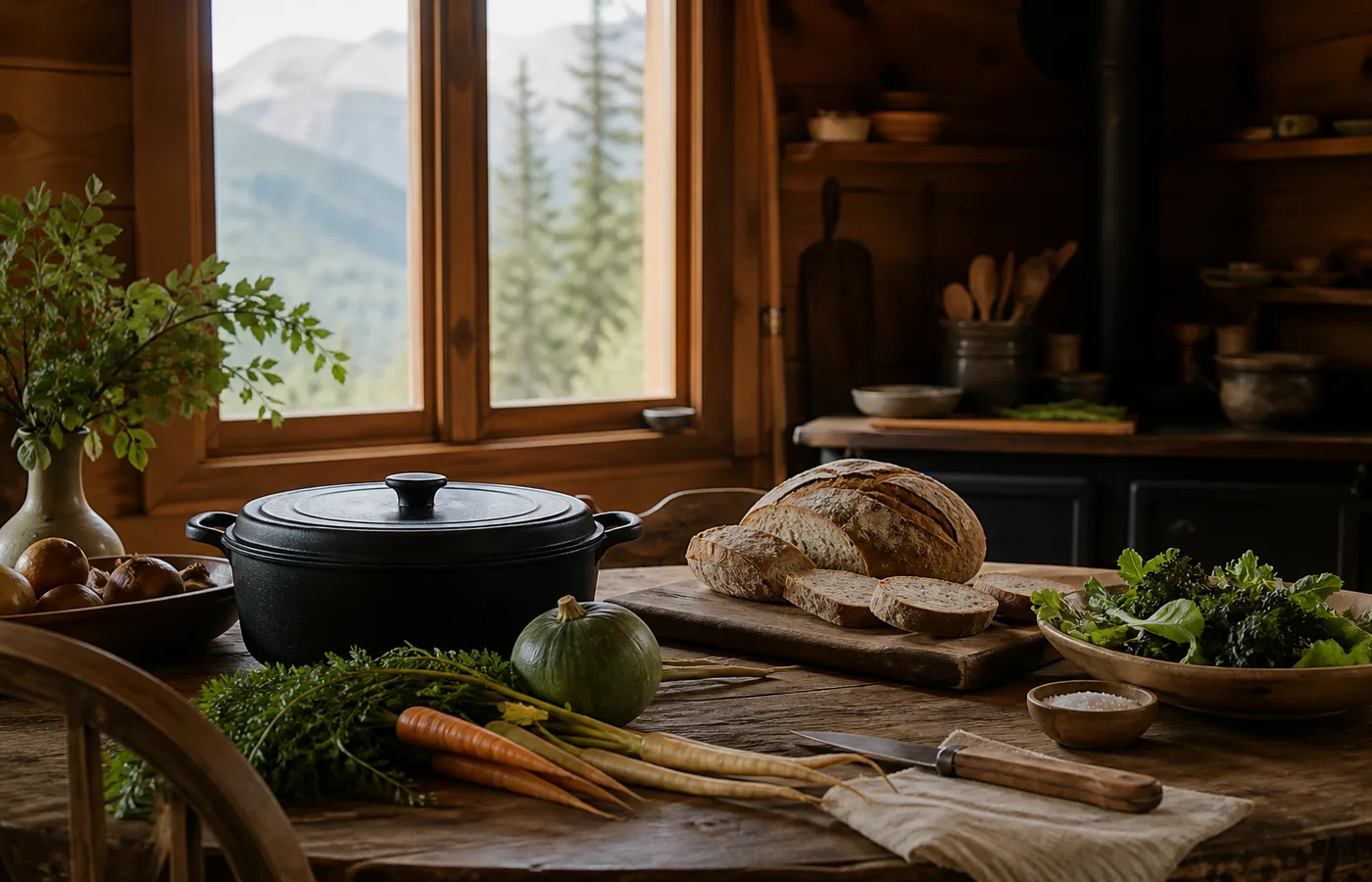
A stone casale in the Subasio hills asks a family for patience and a willingness to move at the pace of the house. The walls hold cool air in summer and release it slowly at night, so rooms are opened and closed according to the hour rather than the thermostat. Water arrives from a cistern or a spring, the garden decides part of the menu, and the nearest bakery is a short drive down a white road. A week here is less a holiday from routine than a different routine, built around light, meals, and the distance to the trailhead.
What does a stone casale in the Subasio hills ask of a family arriving for a week?
The first request is logistical. A casale is often reached by an unpaved road that climbs between olive terraces, and a small car handles it better than a large one. The second is practical: bring shoes that can get muddy, a torch for the walk between the house and the parking area after dinner, and layers for evenings that turn cool even in July. The third is social. These houses sit inside working landscapes, so a family that greets the neighbours, keeps gates closed, and asks before picking anything from a tree will find the week easier.
Inside, the rhythm is old. Stone floors stay cold, shutters do the work of air conditioning, and the kitchen is usually the largest room because it was once the centre of the farm. Children adapt quickly to this arrangement. They learn which door sticks, where the water tap is, and how far they can wander before someone calls them back. Adults take longer. The reward is a week that feels less like a stay and more like a temporary membership in a place. For families who want this kind of week explained in Italian, with attention to the same stone houses, gardens and paths, an agriturismo in the Subasio park keeps a running notebook of the area.
How do the olive grove, the vines and the kitchen garden connect on an Umbrian farm stay?
On a working farm around Assisi, the three are not separate features. They are one system read at different heights. The olive grove occupies the lower slopes and the terraces, where drainage is good and the sun arrives early. The vines take similar ground but usually a different exposure, often on the steeper side of a valley where air moves and mildew is less of a problem. The kitchen garden sits closest to the house, on the flattest and most watered ground, because it needs daily attention.
The connection shows up in the kitchen. Olive oil pressed in November is used through the following year, and its flavour changes as it ages, sharper in spring, softer by autumn. Wine from local grapes is often simple and drunk young, table wine rather than something cellared. The garden supplies the vegetables that make the zuppe and the legumi that appear on nearly every menu: lentils from Castelluccio, chickpeas, beans dried on strings, greens cooked with garlic and oil. A family that spends a week on such a farm usually ends up cooking at least one meal from what is at hand, which is the point.
Which walks leave Santa Maria degli Angeli for the park and its borghi?
Santa Maria degli Angeli sits on the plain below Assisi and works well as a starting point because it is flat, served by trains, and close to the lower edges of the park. From the basilica, a walker can head uphill toward Assisi itself, roughly an hour on foot, and then continue beyond the town toward the Eremo delle Carceri, the hermitage on the wooded slope of Monte Subasio. That route climbs steadily and passes through holm oak before reaching the stone buildings and the small spring nearby.
Other paths leave the plain in different directions. One goes toward Spello, another toward the lower villages that ring the mountain, and a longer route reaches the summit area of Monte Subasio at about 1290 metres, where the ground opens and the views run across the valley. Cyclists use many of the same tracks, especially the gravel roads that cross the park between Santa Maria degli Angeli, Assisi and Spello. The park authority marks trails, but signage is not uniform, so a map and a charged phone are worth carrying. In August, the plain is hot and the mountain is not, which is why so many walks begin early.
What changes between the plain and the mountain
The park covers a real range of elevation, and the difference is felt within a single walk. Olive groves and vines dominate the lower slopes. Higher up, the land turns to oak, then to open grassland used for grazing. The stone changes too, from the pale limestone of the plain to the pink and white stone of the mountain, which is the same material used in the walls of Assisi. A family that walks the same path twice in one week will notice the shift in what is flowering, what is being cut, and what is being harvested.
When the rural calendar fills the roads
Rural life here still follows a calendar, and visitors meet it whether they plan to or not. Olive harvest runs from late October into November, when nets appear under the trees and the frantoi work late. Grape harvest comes earlier, usually in September. Religious festivals mark the summer, and the 12 August feast is one of the dates when villages around the mountain fill with processions, food stalls and music. These are working events as much as celebrations, and they are the clearest way to see how the plain, the borghi and the mountain are connected.
A family that arrives for seven days usually settles into a pattern by the third morning. Breakfast is slow, the garden is watered, and one outing is chosen rather than three. Lunch is often the main meal, built around zuppe, legumi, bread and oil. The afternoon is for the pool, a book, or a short walk to a neighbouring farm. Dinner is late and light. By the end of the week, the distances that felt long on the first day, from the house to the village, from the village to the trailhead, have become ordinary. That is the measure of a stay in the Subasio hills: not what was seen, but what became familiar.