North Yorkshire Coast Without a Car
A car-free guide to the North Yorkshire coast between Staithes and Robin Hood’s Bay, using the Cleveland Way, the Cinder Track and the Esk Valley line.
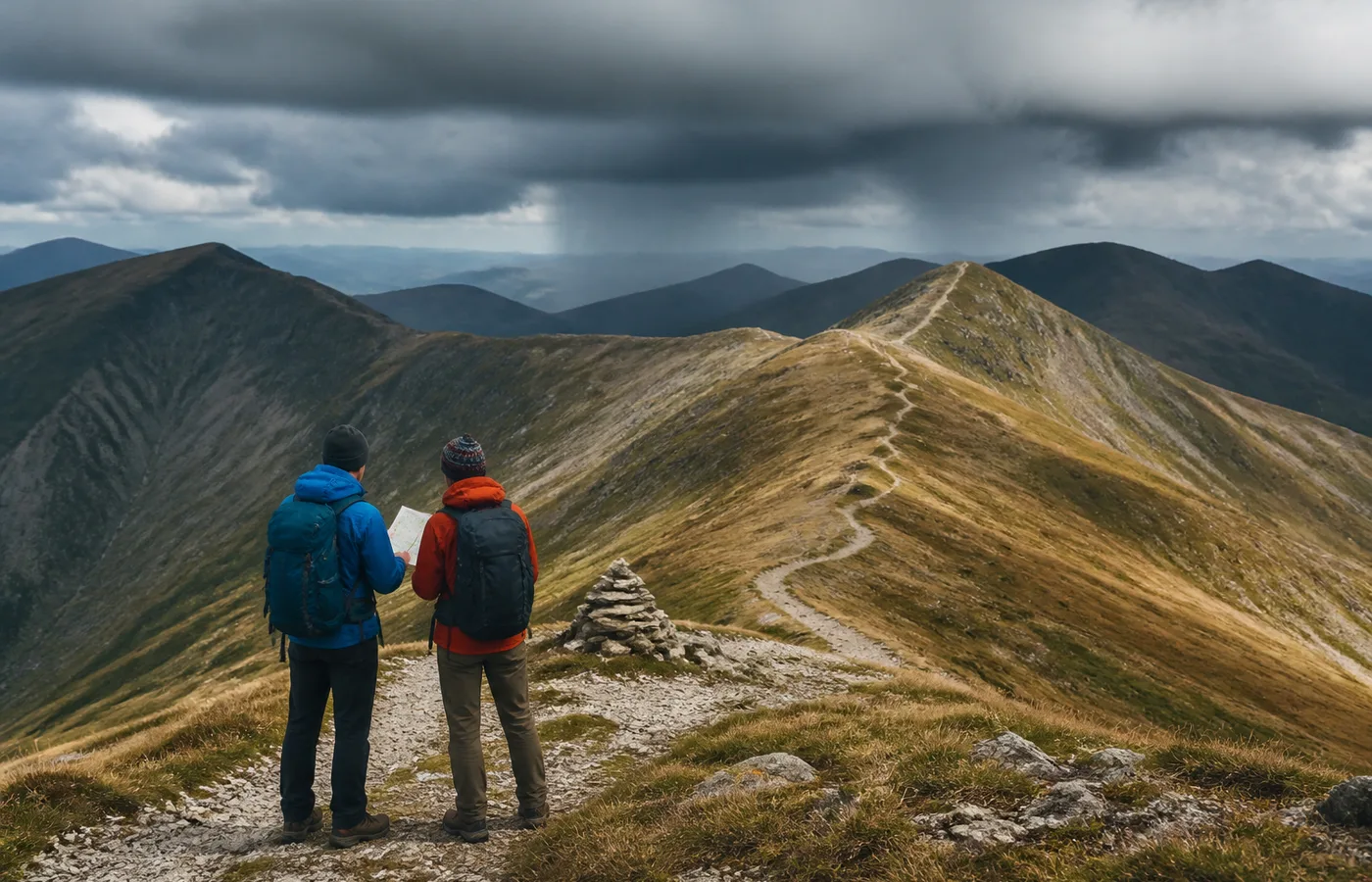
The coast between Staithes and Robin Hood’s Bay can be walked and ridden without a car. The Esk Valley line and the local bus network connect Whitby, Sleights, Staithes and the villages in between, and the Cleveland Way and the Cinder Track cover most of the ground on foot or by bicycle. A car helps with luggage and timing, but it is not required to see the shore.
What is there to see in Sandsend and East Row without a car?
Sandsend sits at the mouth of the East Row beck, about three miles north of Whitby. The beach is the main draw: a long run of sand and rock that changes shape with the tide, with the cliff path above it forming part of the Cleveland Way. East Row is the older settlement at the beck mouth, a short row of houses and a bridge, and the two names are often used for the same stretch of coast.
Without a car, the simplest approach is the bus from Whitby, which stops on the main road through Sandsend. The walk from Whitby along the shore at low tide, or on the path above the cliffs, takes about an hour and is one of the more straightforward legs on this coast. At Sandsend there is a small car park, a pub, and a cafe near the beach, and the beach itself is free and open.
The old alum works lie on the cliff above Sandsend, reached by a path from the village. Alum was processed here from the sixteenth century, and the remains are low walls and hollows rather than standing buildings. The walk up is short but steep in places. A fuller account of Sandsend and East Row, including the alum history and the beach, is kept at Sandsend East Row car-free, which covers this stretch of coast in detail.
For a car-free visitor, Sandsend works as a half day or a full day: beach, cliff path, alum remains, and a return to Whitby by bus or on foot. There is no station at Sandsend, so the bus or the path are the only options.
Why is Staithes worth visiting on a car-free North Yorkshire coast trip?
Staithes is a village at the bottom of a steep bank, with a harbour, a small beach and a maze of narrow streets. It was a fishing village and later an artists’ colony, and the two histories are still visible in the shape of the place. The harbour wall, the Cod and Lobster pub, and the view back up the bank are the usual landmarks.
Reaching Staithes without a car is possible by bus from Whitby or from Saltburn, with the stop at the top of the village and a walk down to the harbour. There is no railway station at Staithes itself. The nearest station on the Esk Valley line is at Sleights, several miles inland, so the bus is the practical link.
What makes Staithes worth the detour is the combination of a working harbour, a beach that is small but usable, and a set of paths that connect to the Cleveland Way. The cliff path north toward Runswick Bay and south toward Skinningrove is part of the national trail. The village also has a small museum in the old chapel, and the Captain Cook connection: he is said to have worked here as a young man.
For a car-free trip, Staithes is a natural stop between Whitby and the northern end of the coast. It can be done as a day trip by bus, or as an overnight stop if you want to walk the cliff path in both directions.
How do I reach Runswick Bay without a car and what should I do there?
Runswick Bay is a curved bay with a village of white houses tucked under the cliff. The beach is sand and rock, and at low tide the rock pools are the main attraction. The village itself is small, with a pub and a few houses, and the cliff path above it is part of the Cleveland Way.
Without a car, Runswick Bay is reached by bus from Whitby or from Staithes, with the stop on the main road above the bay and a walk down. The descent is steep but short. There is no station. The bay is also on the Cleveland Way, so it can be reached on foot from Staithes to the north or from Whitby to the south, though the southern leg is longer.
What to do there: walk the beach at low tide, look at the rock pools, and take the cliff path for the view back over the bay. The village has a pub and a small shop, and the beach is the main reason to come. The bay is exposed, so wind and tide matter more than in the sheltered harbours.
The beach and Whitby in two days
Whitby is the practical base for this coast without a car. The town has a railway station on the Esk Valley line, with trains to Middlesbrough and connections onward, and a bus station with routes along the coast. The beach at Whitby is split by the harbour: the west side is sand and the east side is smaller, under the abbey.
The abbey ruins stand on the headland above the town, reached by the 199 steps from the churchyard. The steps are a real climb, and the view back over the harbour is the reward. The church of St Mary is next to the abbey, and the two together are the main historic site in the town.
Two days in Whitby without a car can be arranged around the tide and the train. One day for the town: harbour, abbey, steps, and the beach. One day for a leg of the coast: Sandsend to the north, or Robin Hood’s Bay to the south. The Cinder Track, a former railway line, runs south from Whitby toward Robin Hood’s Bay and is flat and easy to walk or cycle. The Esk Valley line runs inland from Whitby toward Grosmont and Goathland, which is useful if the weather turns.
The Cinder Track and the Esk Valley line
The Cinder Track is a path on the old Whitby to Scarborough railway, and it runs for about twenty miles. The section from Whitby to Robin Hood’s Bay is the most used, with a steady surface and a few climbs. It passes through Hawsker and Fylingthorpe, and it is a practical way to reach Robin Hood’s Bay without a car.
The Esk Valley line is a railway from Whitby to Middlesbrough, with stops at Sleights, Grosmont, Goathland and others. It is useful for reaching the moors and for connecting to the main line at Middlesbrough. Goathland and Beck Hole are on the line, and both are walking country. The line is also the link between the coast and the inland villages, which matters if you are moving between the two without a car.
Practical notes for a car-free trip
The bus network along this coast is the main link between the villages, with Whitby as the hub. Services run to Sandsend, Staithes, Runswick Bay and Robin Hood’s Bay, though timings vary by season and day. The Esk Valley line covers the inland route and connects to the national rail network at Middlesbrough.
Tides matter on this coast. The difference between high and low water is large, and some sections of beach and path are only usable at low tide. The Cleveland Way is waymarked, but the cliff sections are exposed and can be muddy. The Cinder Track is more sheltered and easier underfoot.
Luggage is the main constraint without a car. A single bag and a base in Whitby is the simplest arrangement, with day trips by bus or train. Overnight stops at Staithes or Runswick Bay are possible but the bus timings need checking in advance. The coast is walkable in sections, and the villages are close enough that a car is a convenience rather than a necessity.
Check current conditions
This article provides a planning method, not live route or weather information. Before leaving, consult current local guidance and an official forecast.