Plan a half-day ridge walk with safe turnaround time
A straightforward planning method for a ridge walk that leaves enough daylight, weather margin and energy for the return.
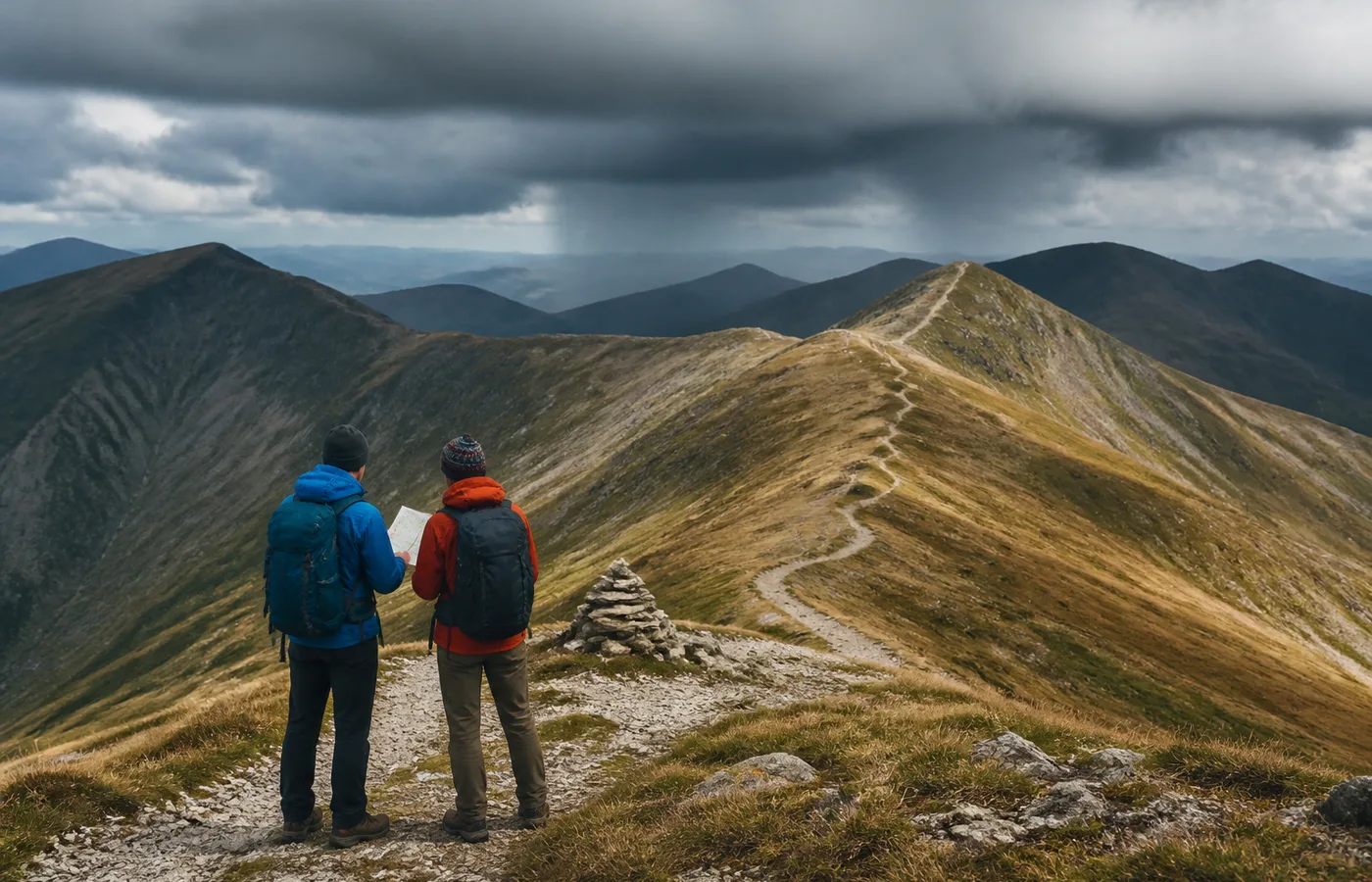
Planning a half-day ridge walk with a safe turnaround time means treating the return as equal to the outward journey. Ridges expose walkers to wind, changing visibility and terrain that can feel easier in one direction than the other. Build the plan around available daylight, the pace of the least experienced participant and a clear decision point. The summit or viewpoint is optional; the agreed return time is not. This approach makes turning back an expected part of good planning rather than a disappointing exception.
Start with a time budget, not a destination promise
Write down the earliest realistic start, the latest acceptable return and the daylight margin you want to preserve. Remove time for breaks, navigation checks and the slower final section. What remains is the walking budget. Divide it conservatively between outward and return travel, remembering that descent is not always faster on loose, wet or unfamiliar ground.
Use route distance and elevation as context, not guarantees. A guidebook estimate cannot know the group, weather or surface you will encounter. Compare the route with something the group has completed recently, then choose a pace that leaves conversation possible. If the calculation only works when everything goes perfectly, the plan is already too tight. Mechanical help changes that arithmetic rather than removing it: a first ascent by cable car or rack railway buys daylight but ties the return to a last departure, so a Schweizer Bergbahnen im Überblick belongs in the plan alongside the forecast.
Name the turnaround point in two ways
A clock time is essential because it works even when progress differs from expectation. Add a physical marker when possible, such as a junction, saddle or distinct contour. The group then knows both when and where the decision is likely to occur. Record the point on the map and say it aloud before starting, while everyone is comfortable and objective.
Agree that reaching the marker late means returning, not renegotiating the whole day under pressure. If the group reaches it early, conditions still decide whether to continue. This two-part rule prevents spare minutes from becoming an automatic invitation to add distance. Time is only one margin; weather, energy and route clarity are margins too.
Watch the weather as a sequence
Check official forecasts and current local guidance before departure, then observe how conditions develop. On a ridge, cloud base, wind, temperature and visibility matter together. A single patch of blue sky does not cancel a broader change. Compare what you see with the forecast timing and keep track of the direction from which weather is arriving.
Choose sheltered places for longer checks and add a layer before becoming cold. If visibility is deteriorating, confirm the return bearing or route while landmarks remain clear. Do not wait for conditions to become dramatic before acting. An early decision often feels uneventful, which is precisely why it preserves the quality of the day.
Plan around the whole group
The sustainable pace belongs to the person who needs the most margin, not the person who feels strongest at the start. Keep the group close enough to communicate without shouting and use short, regular checks for comfort, water and concentration. A person can be quiet because the view is absorbing or because effort is becoming difficult; ask specific, neutral questions rather than assuming.
Share navigation in a way that does not fragment responsibility. One person may hold the map while another watches the time and weather, but everyone should know the broad route and turnaround. If the group separates, a simple walk can become several different plans. Staying together is both a safety measure and part of the social value of the outing.
Keep attention for the way back
Eat and drink before fatigue makes the decision obvious. Check footwear and layers at the turnaround, then reset mentally for the return instead of treating it as an afterthought. Familiar-looking junctions can appear different from the opposite direction, so confirm them rather than following momentum. Marking one or two return landmarks on the outward leg can help.
When the walk is over, compare the planned and actual timing. Note where the pace changed and whether the weather margin felt generous. This is not a scorecard. It is information for the next route. A plan improves when the group records reality without rewarding unnecessary speed or treating a missed summit as failure.
A safe turnaround time does not make a ridge walk smaller. It gives the day a shape that can absorb weather, slower feet and the desire to stop for a view, while still bringing everyone back with attention intact.
Check current conditions
This article provides a planning method, not live route or weather information. Before leaving, consult current local guidance and an official forecast.